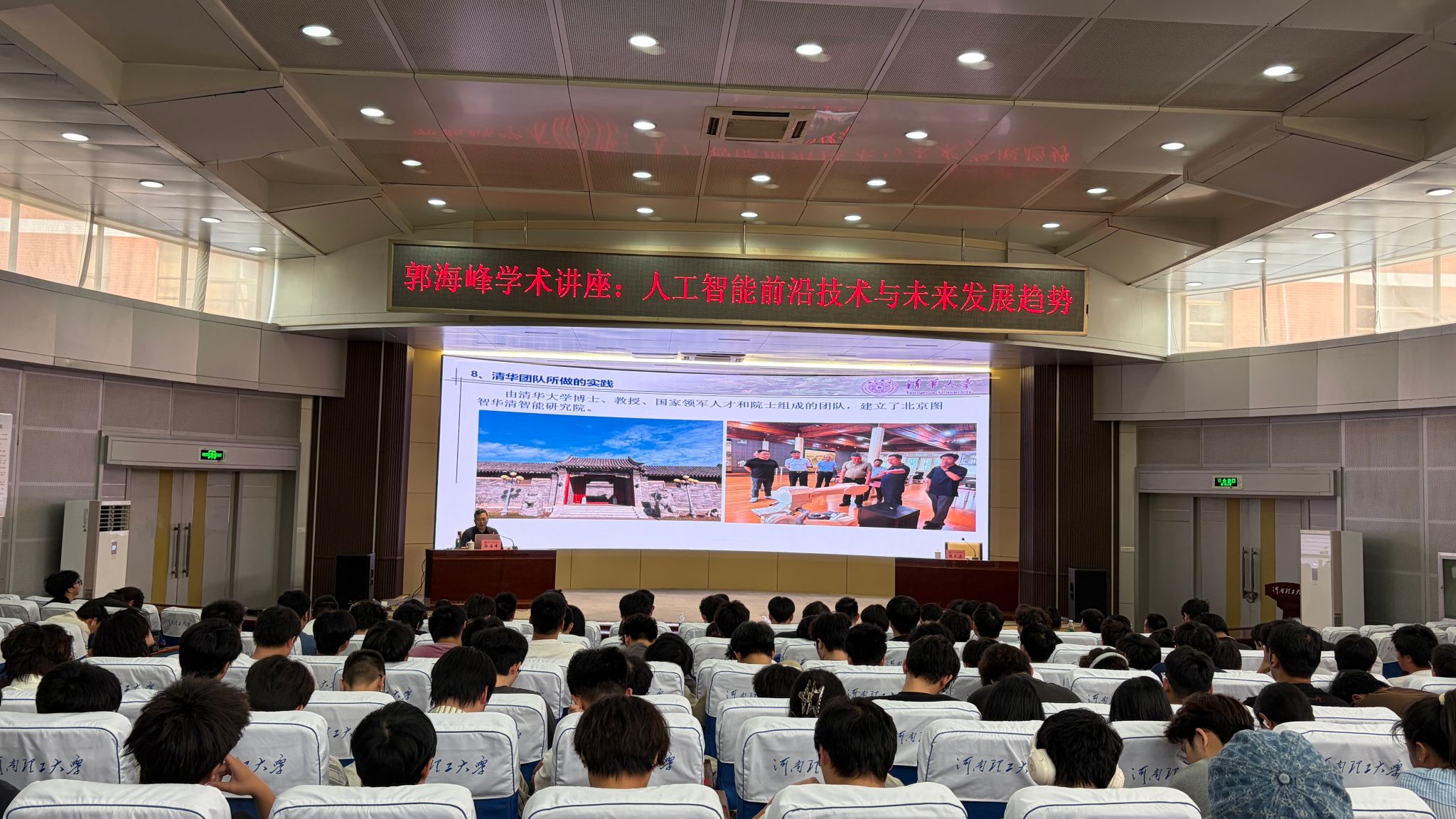
To broaden students' academic horizons and facilitate the deep integration of academic programs with cutting-edge artificial intelligence technologies, on the afternoon of June 17, Professor Guo Haifeng, Dean of Henan Qingxiang Artificial Intelligence Research Institute, was invited to Limerick International College to deliver an academic lecture titled "Cutting-Edge Artificial Intelligence Technologies and Future Development Trends" in the Academic Lecture Hall of Lixing Building. The lecture was hosted by Dean Zhang Changsen, and was attended by undergraduate students of the Class of 2024 and graduate students of the Class of 2025.
At the beginning of the lecture, Dean Zhang Changsen, on behalf of the college, extended a warm welcome to Professor Guo Haifeng and provided a detailed introduction to his industry-academia-research achievements. During the presentation, Professor Guo structured his report around eight major modules. He first traced the development history of artificial intelligence, analyzing the global AI market scale, domestic industrial policies, and the industrial layouts of key cities such as Beijing, Hangzhou, and Shenzhen. He then elaborated on ten major commercial application tracks, including intelligent logistics, machine vision, industrial robotics, and AI-enabled manufacturing, dissecting industry pain points and intelligent transformation pathways. In response to the long-term development of China's AI industry, he put forward four major development recommendations covering industrial planning, data sharing, scenario implementation, and talent cultivation. In the achievement-sharing segment, he showcased a number of industrialization projects from Tsinghua University's Tuzhi Huaqing Intelligent Research Institute, including the Tongsun special-purpose frequency converter—which won a first-place provincial award in an innovation and entrepreneurship competition—high-performance humanoid robots, educational outreach robots, and an edge computing platform. These demonstrations vividly illustrated the complete process of commercializing university research outcomes.
After the lecture, faculty and students engaged in active exchanges and raised questions on topics such as AI employment, innovation and entrepreneurship competitions, and robotics research and development. Professor Guo answered each question thoroughly, fostering a lively discussion atmosphere.
This lecture served as a bridge between theoretical learning and industrial practice in the field of artificial intelligence, deepening the understanding and awareness of AI among all faculty and students across the college. Going forward, the college will continue to bring in high-quality academic resources, focus on cultivating internationally oriented, interdisciplinary engineering talents for the intelligent industry, and support the high-quality development of the college's academic disciplines.


